If you searched for the sleep apnea ICD 10 code, you already know the short answer: G47.3. But if you stop there, your claims will bounce. G47.3 is a notorious category header — not a billable code — and the difference between G47.30, G47.31, and G47.33 is often the difference between a clean claim and a denial that eats weeks of AR follow-up.
With an estimated 30 million adults in the U.S. living with obstructive sleep apnea—80% of whom remain undiagnosed—the volume of testing and durable medical equipment (DME) orders hitting billing departments is at an all-time high. Because sleep disorders span across multiple clinical branches, mastering these nuances is essential for managing pulmonology billing, neurology, and ENT billing specialties effectively.
This guide walks through every layer of sleep apnea ICD-10 coding: the full code family, how to choose between overlapping codes, the documentation that supports each one, related CPT/HCPCS codes for sleep studies and CPAP equipment, Medicare’s coverage rules, how it all ties into MIPS quality reporting, and the clinical context that ties it all together.
What Is the ICD 10 Code for Sleep Apnea?
Sleep apnea falls under ICD-10-CM category G47.3 — Sleep apnea, located in Chapter 6 (Diseases of the Nervous System), under the broader G47 “Sleep disorders” heading.
Here’s what trips up even experienced billers: G47.3 itself is not billable. It’s a parent category. Every claim needs one of its child codes — the specific subtype the provider actually documented.
| Where it sits | Detail |
| Chapter | 6 — Diseases of the Nervous System (G00–G99) |
| Block | G40–G47 — Episodic and paroxysmal disorders |
| Category | G47.3 — Sleep apnea (non-billable parent) |
| Billable codes | G47.30 through G47.39 (nine child codes) |
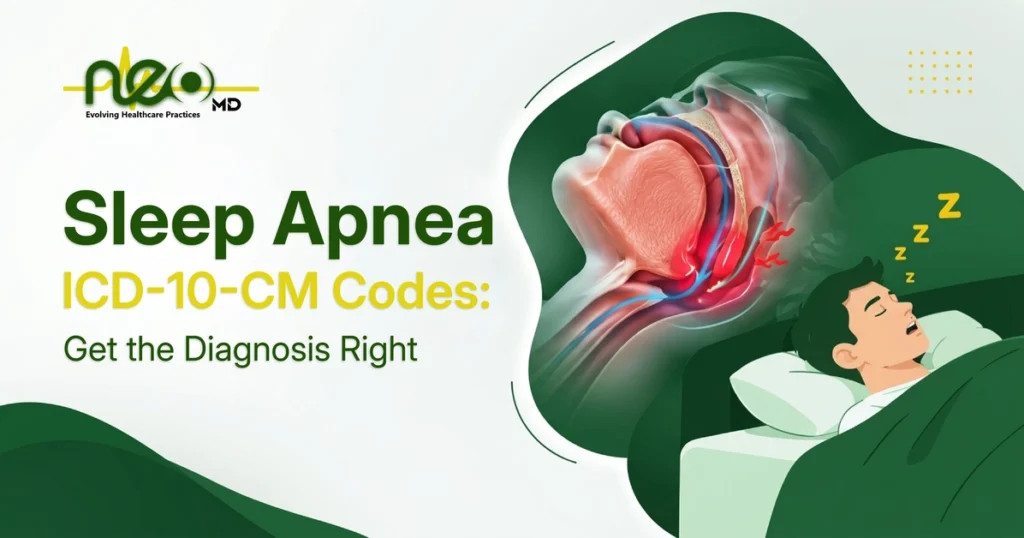
Sleep apnea is a breathing disorder marked by repeated pauses in breathing — or abnormally shallow breathing — during sleep, each lasting 10 seconds or longer. It’s classified as obstructive, central, or mixed. The code you assign depends entirely. On which type the treating provider is documented in the chart.
The Complete Sleep Apnea ICD 10 Code Table
| Code | Description | Billable | When It Applies |
| G47.3 | Sleep apnea (parent category) | No | Never used alone on a claim |
| G47.30 | Sleep apnea, unspecified | Yes | Sleep apnea documented, no subtype named |
| G47.31 | Primary central sleep apnea | Yes | Central apnea, no underlying disease documented |
| G47.32 | High altitude periodic breathing | Yes | Periodic breathing tied to altitude exposure |
| G47.33 | Obstructive sleep apnea (adult) (pediatric) | Yes | OSA documented, any age, any severity |
| G47.34 | Idiopathic sleep-related nonobstructive alveolar hypoventilation | Yes | Hypoventilation, no obstruction, no known cause |
| G47.35 | Congenital central alveolar hypoventilation syndrome | Yes | Congenital syndrome specifically named |
| G47.36 | Sleep-related hypoventilation in conditions classified elsewhere | Yes | Underlying condition documented and sequenced first |
| G47.37 | Central sleep apnea in conditions classified elsewhere | Yes | Central apnea tied to a named underlying disease |
| G47.39 | Other sleep apnea | Yes | Provider documents a type outside the codes above |
Four of these — G47.30, G47.31, G47.33, and G47.39 — account for the majority of real-world claim volume. The rest appear more often in pulmonology, neuromuscular, and pediatric sleep programs.
G47.30 vs. G47.33: How to Choose the Right Code
This is the single coding decision that affects the most claims.
Use G47.30 (unspecified) when the provider has documented “sleep apnea” but hasn’t specified obstructive, central, or another subtype. It’s a legitimate, complete code — not a placeholder to be “upgraded later.”
Use G47.33 (obstructive) when the provider has explicitly documented obstructive sleep apnea, regardless of the patient’s age or disease severity.
The rule governing both: the code follows the provider’s documented diagnosis, not the sleep study’s raw data. A polysomnography report showing obstructive events is clinical evidence — it is not, by itself, a diagnostic statement.
| What the Chart Says | Correct Coding Direction | Why |
| “Sleep apnea icd 10” no type named | G47.30 | No subtype documented |
| “Obstructive sleep apnea” | G47.33 | OSA is the documented diagnosis |
| Snoring and daytime sleepiness only | Symptom code (R06.83) | Diagnosis not yet established |
| Sleep study suggests OSA, note unclear | Query the provider | Never code past the documentation |
If a sleep study confirms OSA but the provider’s active assessment still reads “sleep apnea, unspecified,”. This mismatch needs to be reconciled clinically — not silently corrected by billing.
This exact reconciliation gap is one of the most common issues found during Neo MD coding audits of sleep medicine claims. A periodic audit catches this pattern across a provider’s full chart volume, not just the claim in front of you, before it turns into a denial-and-appeal cycle that can drag on for 60–90 days.
Central Sleep Apnea ICD 10: G47.31 vs. G47.37 Explained
Central sleep apnea coding causes more confusion than any other pair in the G47.3 family.
- G47.31 — Primary central sleep apnea: Central apnea with no underlying disease driving it. A standalone diagnosis.
- G47.37 — Central sleep apnea in conditions classified elsewhere: A manifestation code. This code requires a documented underlying condition (such as heart failure or opioid use). Sequencing rules typically require you to code that underlying condition first.
G47.37 is sometimes mislabeled online as a general “complex sleep apnea” code. It isn’t. Applying it without a documented underlying condition fails coding edits before a human ever reviews the claim.
G47.39 (Other sleep apnea) is appropriate when documentation uses terms like “mixed,” “complex,” or “treatment-emergent” — but only after confirming the provider’s final diagnostic wording, not just mapping the adjective automatically.
Excludes Notes You Can’t Skip
G47.3 carries Excludes1 notes — meaning these conditions should never be coded together with sleep apnea icd 10 for the same encounter:
- R06.81 — Apnea, not elsewhere classified (Apnea NOS)
- R06.3 — Cheyne-Stokes breathing
- E66.2 — Pickwickian syndrome (obesity hypoventilation)
- P28.3- — Sleep apnea of the newborn
The Pickwickian syndrome exclusion catches many sleep clinics off guard. Obesity hypoventilation syndrome and OSA frequently coexist in the same patient, but providers must code them distinctly.
There’s also a “Code also” instruction on G47.3 directing coders to report any associated underlying condition — relevant when heart failure, stroke, or neuromuscular disease accompanies a sleep-disordered breathing diagnosis.
Snoring, Symptoms, and Unconfirmed Diagnoses
Not every sleep complaint is a sleep apnea diagnosis. Before a provider formally establishes the condition. Only the documented symptoms should be coded.
| Documented Finding | Correct Approach | Common Mistake to Avoid |
| Snoring only | R06.83 (Snoring) | Assuming snoring alone justifies G47.33 |
| Witnessed apneic episodes, no diagnosis | Symptom coding | Treating “apnea” as equivalent to G47.3 |
| Excessive daytime sleepiness | Symptom code for the finding | Coding sleep apnea from sleepiness alone |
| “Sleep-disordered breathing,” no subtype | Query the provider | Auto-mapping the phrase to a G47.3 code |
Outpatient coding guidelines are explicit: Do not code a suspected condition as confirmed. If the assessment does not list the diagnosis yet, code the documented symptom, not the suspicion.
What Sleep Apnea Actually Is: A Clinical Overview
Understanding the clinical picture supports better documentation and, by extension, better coding accuracy.
Obstructive vs. Central Sleep Apnea ICD 10
Obstructive sleep apnea (OSA) occurs when the upper airway repeatedly collapses or narrows during sleep despite ongoing respiratory effort, causing breathing pauses and oxygen desaturation. It’s the most common form, affecting an estimated 15–30% of men and 10–15% of women, with obesity as a leading risk factor.
Central sleep apnea (CSA) works differently — the brain temporarily stops sending signals to the muscles that control breathing. It’s less common than OSA and more often linked to heart failure, stroke, or opioid use.
Common Symptoms and Health Risks
- Loud or abnormal snoring
- Witnessed pauses in breathing during sleep
- Excessive daytime sleepiness
- Morning headaches
- Difficulty concentrating and mood changes
Left untreated, sleep apnea is associated with elevated risk of:
- Hypertension
- Cardiovascular disease
- Type 2 diabetes
- Workplace accidents
- Motor vehicle crashes
One reason thorough documentation matters beyond billing.
How Sleep Apnea Is Diagnosed
- Clinical evaluation — history, symptom review, screening tools (Epworth Sleepiness Scale, STOP-BANG)
- Polysomnography (PSG) — attended, in-lab sleep study measuring brain waves, oxygen levels, heart rate, airflow, and muscle activity
- Home Sleep Apnea Testing (HSAT) — a more convenient but less comprehensive alternative for select patients
- Split-night studies — diagnostic monitoring in the first half of the night, followed by CPAP titration in the second half if the clinician confirms OSA
The AHI Scoring Nuance Almost Nobody Explains
Two different thresholds exist for scoring a “hypopnea,” and mixing them up affects both clinical interpretation and coverage decisions:
| AASM Scoring Manual | Medicare Coverage Policy | |
| Desaturation threshold | 3% oxygen drop or an arousal | 4% oxygen drop |
| Purpose | Clinical scoring | Coverage determination for CPAP |
| Arousal-based events | Counted | Excluded from AHI/RDI |
A sleep report can show a qualifying AHI under the clinical (3%) standard but fall short under Medicare’s stricter (4%) definition. Confirm which threshold the payer’s policy applies before submitting a CPAP claim.
Related CPT and HCPCS Codes for Sleep Apnea Care
ICD-10-CM tells the payer why a clinician performed a service. CPT and HCPCS codes tell the payer what the clinician did. These are separate code sets and are never interchangeable.
Sleep Study Codes
| Code | Description |
| 95800 / 95801 | Unattended sleep study, with/without sleep time |
| 95806 | Unattended study with airflow and effort |
| 95810 | Attended diagnostic polysomnography (age 6+) |
| 95811 | Attended polysomnography with PAP titration (age 6+) |
| 95782 / 95783 | Attended PSG / PSG with titration, under age 6 |
| G0398 / G0399 / G0400 | Medicare home sleep test tiers (Type II/III/IV) |
CPAP/BiPAP Equipment Codes
| Code | Equipment |
| E0601 | Standard single-level CPAP device |
| E0470 | Bilevel device, no backup rate (requires documented failed E0601 trial) |
| E0471 | Bilevel device with backup rate (typically for CSA, not OSA) |
Oral Appliance Codes
| Code | Description |
| E0486 | Custom-fabricated mandibular advancement device |
| E0485 | Prefabricated appliance (often non-covered for OSA under Medicare) |
There’s no such thing as a combined “CPAP diagnosis code.” The Sleep Apnea ICD-10-CM diagnosis (e.g., G47.33). The HCPCS equipment code are always reported separately.
Getting the diagnosis-to-equipment pairing wrong is one of the most frequent triggers for DME claim rejections. Neo MD coding team audits this exact ICD-10-to-HCPCS crosswalk as part of routine chart reviews — flagging mismatches between the documented diagnosis and the billed equipment code before a claim goes out the door.
Medicare CPAP Coverage: What the Claim Actually Needs
A correct G47.33 diagnosis code does not, by itself, guarantee CPAP coverage. Medicare’s national coverage framework requires:
- An adult beneficiary with a qualifying OSA diagnosis
- A qualifying sleep test (AHI/RDI ≥15, or 5–14 with a documented symptom such as hypertension, daytime sleepiness, or history of stroke)
- Beneficiary education from the equipment supplier before use
- Initial coverage for a 12-week trial period
- Continued coverage requiring an in-person practitioner reevaluation between day 31 and day 91, plus documented adherence of at least 4 hours per night on 70% of nights within a consecutive 30-day window
Relevant modifiers include:
- KX (coverage criteria met)
- GA/GZ (expected denial, with or without a valid ABN)
- EY (required order not yet received).
Commercial payers frequently set their own authorization and adherence rules that differ from Medicare’s — don’t assume the Medicare timeline applies universally.
This multi-step compliance window is easy to lose track of manually. Neo MD RCM team builds these deadlines directly into claim workflows so continued-coverage documentation doesn’t fall through the cracks between the sleep lab, the ordering provider, and the DME supplier.
Common Reasons Sleep Apnea Claims Denials
| Symptom | Likely Root Cause |
| G47.33 on claim, CPAP still denied | Missing qualifying sleep test or clinical evaluation |
| G47.30 lingers after OSA is confirmed | Diagnosis not reconciled between sleep report and problem list |
| PAP claim billed with E0470 | No documented failed E0601 trial on file |
| Fourth-month PAP claim denies | Missing day 31–91 reevaluation or adherence data |
| Oral appliance claim denies | Missing qualifying test, order, or delivery documentation |
A clean ICD 10 for sleep apnea code gets a claim to the starting line — it doesn’t finish the race. The surrounding documentation is what actually determines payment.
Recurring denials in any of these categories usually point to a workflow gap rather than a one-off mistake — the kind of pattern Neo MD auditing and denial management teams look for when reviewing a practice’s sleep medicine claim history: not just fixing the claim in front of them, but finding where in the process the breakdown keeps starting.
Why Sleep Apnea Documentation Matters for MIPS Reporting
Sleep apnea coding doesn’t stop at claim payment — it also feeds into MIPS (Merit-based Incentive Payment System) quality and risk-adjustment reporting for providers who report under it.
- Comorbidity capture — Sleep apnea frequently coexists with hypertension, heart failure, type 2 diabetes, and obesity. Under-documenting the diagnosis (or leaving it at G47.30 when a specific subtype is known) can understate patient complexity in risk-adjustment models.
- Quality measure alignment — Practices reporting sleep medicine or pulmonology measures need consistent, specific coding across the patient population to accurately reflect performance.
- Documentation completeness — Accurate problem-list maintenance (active vs. historical OSA) directly supports data completeness requirements under MIPS categories.
The same coding habit that causes a CPAP denial — leaving G47.30 on the chart after a subtype is confirmed. Often costs practice points on a quality measure too. Neo MD MIPS reporting team works alongside its coding auditors specifically to catch this overlap.
Treatment Approaches for Sleep Apnea
Treatment doesn’t change the diagnosis code, but documenting it thoroughly supports both clinical care and coverage decisions:
- Lifestyle changes — weight management, reduced alcohol/sedative use before bed, positional therapy
- Positive airway pressure (CPAP/BiPAP) — first-line treatment for moderate-to-severe OSA
- Oral appliances — mandibular advancement devices for mild-to-moderate OSA or CPAP-intolerant patients
- Surgical options — UPPP, maxillomandibular advancement, and other airway procedures for select cases
- Emerging options (2026) — tirzepatide (approved for moderate-to-severe OSA in adults with obesity) and hypoglossal nerve stimulation implants for PAP-intolerant patients
None of these newer treatments introduced a new sleep apnea ICD 10 CM diagnosis code — the underlying G47.3x codes remain unchanged; only the associated CPT codes for implant procedures (64582–64584) the billing picture.
Frequently Asked Questions
What is the ICD-10 code for sleep apnea, unspecified?
G47.30 is used when a provider documents sleep apnea without specifying
- Obstructive
- Central
- Or another subtype.
Is obstructive sleep apnea G47.30 or G47.33?
NeoMD codes obstructive sleep apnea as G47.33. Our team reserves G47.30 for cases where the provider’s documentation does not specify a subtype.
Can G47.3 be billed on its own?
No. G47.3 is a non-billable parent category. A claim must use one of its child codes (G47.30–G47.39).
Is there a separate ICD-10 code for CPAP use?
No. CPAP equipment is billed under HCPCS (e.g., E0601), separate from the ICD-10-CM diagnosis code (e.g., G47.33).
Does sleep apnea severity change the ICD-10 code?
No. You report mild, moderate, and severe OSA all as G47.33. ICD-10-CM does not offer severity-specific subcodes. However, you must still document the severity, since it affects treatment and coverage decisions.
Getting Sleep Apnea ICD 10 Coding and Billing Right, Every Time
Accurate ICD-10 coding is only one link in the chain that determines whether a payer approves a sleep medicine claim—and whether your documentation supports strong performance under value-based reporting programs. The diagnosis must match the documentation. You must match the CPT/HCPCS codes to the diagnosis, and you must track the payer’s coverage rules from the first sleep study through the day-91 reevaluation.
Neo MD is a full-service medical billing, coding, auditing, MIPS, and revenue cycle management company that works with sleep medicine, pulmonology, and DME practices to keep that entire chain connected — from coding accuracy audits and documentation review, to claim submission, denial resolution, and MIPS quality reporting.
If your practice is dealing with recurring sleep apnea or CPAP denials, wants a coding audit ahead of a payer review, or needs help aligning documentation with MIPS reporting requirements, reach out to Neo MD team for a free claims and coding review.