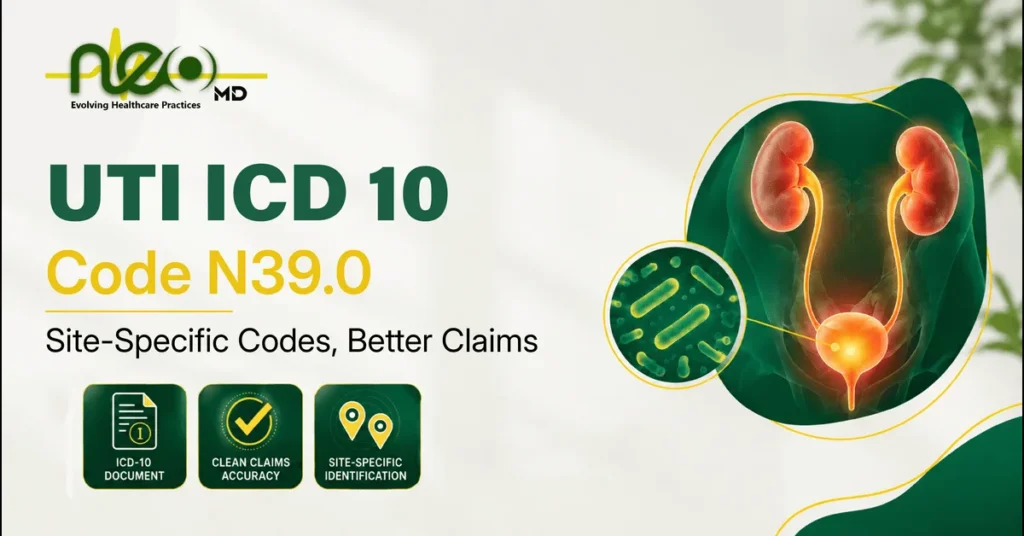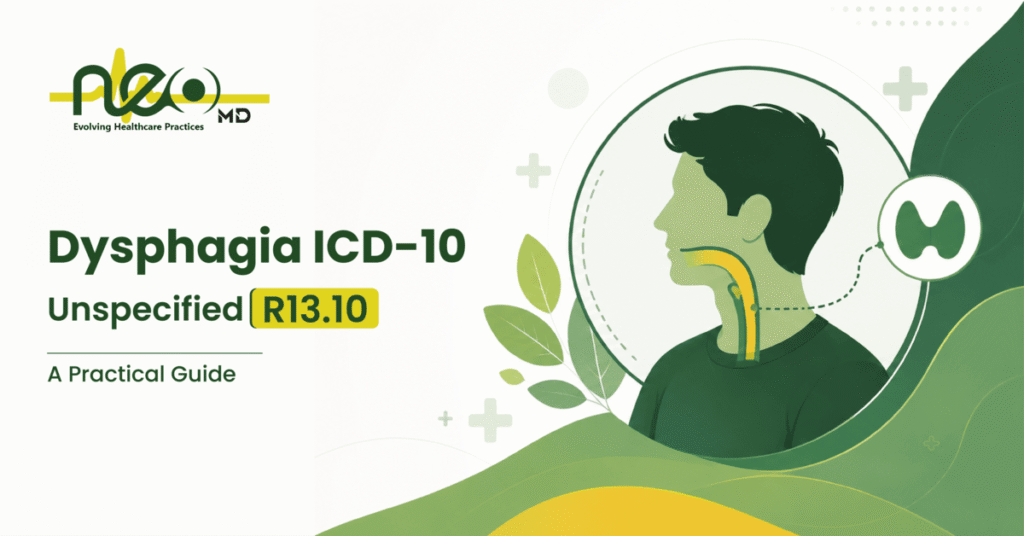
The primary ICD 10 CM code for dysphagia is R13.10 (unspecified dysphagia). More specific codes exist for oral (R13.11), oropharyngeal (R13.12), pharyngoesophageal (R13.14) and esophageal (R13.19) dysphagia. Plus I69.391 for post-stroke dysphagia. Use the most specific code your documentation supports unspecified codes are a leading cause of denials.
The quiet failures in medical coding rarely announce themselves. They surface later, in the form of denials, rework, and uneasy audits. Few areas show this more clearly than dysphagia coding. The condition appears simple at first glance the dysphagia icd 10 structure beneath. It demands precision that documentation often fails to provide.
Dysphagia is not rare, nor is it marginal. Studies suggest it affects nearly 15%–20% of adults over the age of 50, with prevalence rising sharply in hospitalized and post-stroke populations.
Dysphagia ICD 10 codes fall under the R13 category and specific codes identify the type and cause of swallowing difficulty.
This guide examines dysphagia ICD-10 coding through a practical lens. It explains how to select the correct code and understand clinical nuance, documentation standards, and denial risks that surround it.
What Is Dysphagia?
Dysphagia refers to impaired swallowing, making it difficult for a person to safely or effectively move food, liquids or saliva from the mouth into the stomach. It is a clinical symptom rather than a standalone disease. This is commonly associated with:
- Neurological disorders
- Cerebrovascular accidents (stroke)
- Parkinson’s disease
- Esophageal disorders
- Head and neck cancers
And there’s a lot of other conditions that affect the swallowing mechanism.
For ICD 10 dysphagia coding, precise clinical documentation is critical. Providers should document the specific phase of dysphagia oral, oropharyngeal, pharyngeal, or pharyngoesophageal. Because each diagnosis may correspond to a different ICD-10-CM code.
Understanding Dysphagia ICD 10 in Clinical Context
Dysphagia icd 10 is not a single entity. It is a symptom with multiple anatomical and neurological coding origins.
Clinically, swallowing occurs in three phases:
- Oral phase: voluntary control, involving chewing and bolus formation
- Pharyngeal phase: reflex-driven transfer through the throat
- Esophageal phase: transport into the stomach
Consequently, disruption in any of these phases produces different clinical patterns. For example, a patient who struggles to initiate swallowing presents differently from one who feels food lodged in the chest. The documentation often compresses these distinctions into a single phrase: “difficulty swallowing.”
ICD 10 Code Structure for Dysphagia (R13 Category)
ICD-10 groups dysphagia under category R13, which allows varying levels of specificity. The distinction between these codes is not cosmetic. It directly influences claim acceptance and clinical clarity.
The temptation to default to R13.10 is widespread. It is also one of the most common sources of preventable denials. Unspecified codes signal incomplete documentation. In an environment where payers increasingly rely on automated validation, this lack of detail rarely passes unnoticed.
A more precise Dysphagia ICD 10 coding, when supported by documentation, does more than satisfy billing requirements. It reflects a coherent clinical narrative.
| Code | Description | When to Use |
| R13.10 | Dysphagia, unspecified | When no detail is documented |
| R13.11 | Oral Dysphagia | Difficulty initiating swallowing |
| R13.12 | Oropharyngeal dysphagia | Difficulty moving food from mouth to throat |
| R13.14 | Pharyngoesophageal dysphagia | Transition phase issues |
| R13.19 | Esophageal dysphagia | Food sticking in chest |
Clinical Specificity: When Each Code Applies
Coding icd 10 dysphagia correctly requires attention to how symptoms are described, not merely that they are present.
- Unspecified dysphagia
Appropriate only when documentation lacks sufficient detail, not when detail exists but is ignored. - Oropharyngeal dysphagia
Typically associated with neurological impairment. Patients may cough, choke, or struggle to initiate swallowing. Common in stroke or neurodegenerative disease. - Pharyngoesophageal dysphagia
Represents a transition issue between throat and esophagus coding. Often documented in swallow studies rather than routine clinical notes. - Esophageal dysphagia
Characterized by the sensation of food sticking in the chest. Frequently linked to structural abnormalities such as strictures or motility disorders.
Documentation Requirements in Dysphagia ICD 10 That Support Accurate Coding
The strength of a dysphagia code depends entirely on documentation. Wthout it, even the correct code becomes indefensible.
High-quality documentation often includes:
- Clear description of symptoms
- Identification of swallowing phase affected
- Diagnostic confirmation through testing
- Supporting notes from speech-language pathology billing
Tests such as barium swallow studies or fiberoptic endoscopic evaluation of swallowing (FEES) provide objective evidence. These findings are only useful if physicians reflect them in documentation. These coders cannot infer specificity from isolated reports.
Consider the difference:
Weak documentation: “Patient has dysphagia.”
Strong documentation: “Patient demonstrates oropharyngeal dysphagia with delayed swallow initiation and aspiration risk confirmed on FEES.”
Clearly, the second supports precise coding, while the first invites ambiguity.
Common Coding Errors That Lead to Denials
Errors in icd 10 dysphagia coding are rarely complex. They are repetitive and almost procedural.
- Overuse of dysphagia unspecified icd 10 codes
Reliance on R13.10 despite available clinical detail signals weak coding discipline. - Ignoring underlying conditions
Dysphagia often results from another diagnosis. Therefore, coding it in isolation can misrepresent medical necessity. - Documentation mismatch
When clinical notes suggest one type of dysphagia but the code reflects another, claims face scrutiny. - Failure to query physicians
Ambiguity should trigger clarification, not assumption. However, skipping this step introduces avoidable risk.
Each of these errors shares a common feature. They arise not from lack of knowledge, but from lack of attention.
Linking Dysphagia to Underlying Conditions
Dysphagia rarely exists alone. It is frequently a manifestation of broader pathology.
Common associations include:
- Neurological events such as stroke
- Gastroesophageal reflux disease coding
- Esophageal strictures
- Progressive neurological disorders
The coding decision hinges on whether dysphagia icd 10 is a primary concern or a secondary symptom. When linked to an underlying condition, both may need to be reported, depending on clinical relevance and documentation.
This is not merely a technical distinction. It shapes how payers interpret the necessity and context of care.
Dysphagia ICD 10 Psychogenic Dysphagia Code (F45.8): When Swallowing Issues Are Non-Physical
Not all swallowing difficulties stem from structural or neurological causes. In some cases, the origin is functional or psychological.
- Psychogenic dysphagia (F45.8)
This code applies when dysphagia arises from psychological conditions rather than physical abnormalities. Clinicians typically consider it after they rule out organic causes.
Accurate use requires clear documentation that links symptoms to psychological factors. Without this, the diagnosis may be questioned during review.
Dysphagia ICD 10 Feeding Difficulties Code (R63.3): When It’s Not True Dysphagia
Certain cases, particularly in pediatric or non-specific presentations, may fall outside strict dysphagia classification.
- Feeding difficulties (R63.3)
This code is often used when patients experience feeding challenges without clear evidence of oral or pharyngeal dysfunction. It is common in pediatric populations or cases involving behavioral feeding issues.
It should not replace dysphagia codes when swallowing impairment is clinically confirmed.
Dysphagia ICD-10 Esophageal Causes: K22.2 and K22.4
When dysphagia is linked to structural or motility disorders, coding should reflect the underlying pathology.
- Esophageal obstruction (K22.2)
Used when physical blockage, such as strictures, causes swallowing difficulty. - Esophageal dyskinesia (K22.4)
Applied in cases of abnormal esophageal motility affecting food transit.
In such cases, icd 10 dysphagia esophageal may be coded alongside or as secondary to these conditions, depending on documentation and clinical relevance.
When to Use I69.391 for Post-Stroke Dysphagia
Coding errors often occur when dysphagia is treated as a symptom despite a known cause. When it follows a prior stroke, coders should not default to an R13 code. ICD-10 provides I69.391 to capture both the symptom and its origin.
This code applies when dysphagia icd 10 persists after a cerebral infarction. It shifts the diagnosis from a simple symptom to a neurological consequence, which strengthens both clinical accuracy and billing relevance.
In practice, documentation must clearly link dysphagia following stroke icd 10. Phrases like “dysphagia secondary to CVA” support its use. Otherwise, using an R13 code weakens accuracy.
Ultimately, the rule is simple: when the cause is known, code the sequela. When it is not, code the symptom.
Impact on Reimbursement and Revenue Integrity
In the revenue cycle, specificity translates into stability. Vague coding introduces friction at multiple stages and directly impact on revenue cycle growth.
Getting denied on unspecified dysphagia claims? NEO MD’s certified coders review documentation for specificity. Before submission reducing R13.10 overuse and the denials that come with it. Get a Free Coding Accuracy Audit.
Accurate dysphagia icd 10 coding supports:
- Clear demonstration of medical necessity
- Reduced likelihood of claim rejection
- Stronger audit defensibility
- Consistent reimbursement patterns
Conversely, imprecise coding invites delays. It increases administrative burden and erodes confidence in documentation practices.
The difference between R13.10 and a more specific code may appear minor. In aggregate, it shapes the financial health of an organization.
Real-World Coding Scenarios
Alinical dysphagia classification research gains meaning when applied to real situations.
Scenario 1: Post-stroke patient
A patient presents with difficulty initiating swallowing following a cerebrovascular event. Documentation confirms aspiration risk.
- Appropriate code: R13.12 (oropharyngeal dysphagia)
- Rationale: Symptom pattern and neurological origin align clearly
Scenario 2: Elderly patient with vague symptoms
Patient reports general difficulty swallowing without detailed evaluation.
- Appropriate code: R13.10 (unspecified), pending further clarification
- Rationale: Lack of detail justifies temporary use, not permanence
Scenario 3: Esophageal obstruction
Patient describes food sticking in the chest. Imaging confirms structural narrowing.
- Appropriate code: R13.19 (esophageal dysphagia)
- Rationale: Symptom location and diagnostic findings support specificity
These scenarios illustrate a consistent principle. Coding follows documentation, but documentation can be shaped through deliberate inquiry.
Dysphagia ICD 10 Best Practices for Consistent Coding Accuracy
Reliable dysphagia coding does not depend on isolated effort. Instead, it emerges from structured habits.
- Encourage precise clinical language at the point of care
- Use physician queries as a routine tool, not a last resort
- Align coding teams with speech therapy and diagnostic findings
- Treat unspecified codes as temporary placeholders
Accuracy is not achieved through complexity. It is achieved through consistency.
CPT Codes for Dysphagia Evaluation and Treatment
In dysphagia care, procedural coding reflects the clinical pathway with measured precision. Each code captures a distinct moment in evaluation or intervention, shaping how services are understood and reimbursed.
- CPT 92526 – Treatment of swallowing dysfunction and oral feeding
- CPT 92611 – Motion fluoroscopic evaluation of swallowing
- CPT 92612 – Flexible fiberoptic endoscopic evaluation
- CPT 70370 – Radiologic exam of pharynx and larynx
- CPT 74230 – Fluoroscopic imaging to detect swallowing disorders and aspiration.
- HCPCS V5364 – Screening for swallowing disorders
Together, these codes outline a coherent record of care, linking diagnostic inquiry with therapeutic response while preserving clarity in documentation and reimbursement.
Why NEO MD Is the Best for Dysphagia Coding
Dysphagia coding demands precision, yet routine workflows often fail to sustain it. Choosing between symptom-based and sequela codes depends on careful reading, not speed. NEO MD strengthens this process by bringing structure and consistency. For a multi-provider ENT and neurology group, Neo MD’s specificity review reduced unspecified-code claims by 8% within 90 days — cutting related denials and improving audit defensibility.
It aligns documentation with coding logic, ensuring key details like swallowing phase and neurological origin are not missed. When documentation supports specificity, it is applied; when it does not, gaps are identified early before they lead to denials.
Rather than treating coding as routine work, NEO MD manages medical billing and coding it as a controlled system. As a result, documentation, code selection, and denial risk stay aligned, which is essential for accurate icd 10 for dysphagia coding.
Future Outlook: Increasing Demand for Precision
Healthcare coding continues to move toward greater scrutiny. Automated claim reviews, predictive analytics, and tighter payer policies are reshaping expectations.
Dysphagia icd 10 coding will not remain exempt from this shift.
Greater emphasis will fall on:
- Detailed clinical documentation
- Integration of diagnostic findings
- Reduction of unspecified coding
- Alignment between clinical and administrative data
Consequently, those who adapt early will find fewer disruptions. Those who rely on habit will encounter increasing resistance.
Closing Reflection
Dysphagia ICD-10 coding is not inherently difficult. What makes it challenging is the gap between what is known and what is written.
A code is only as strong as the narrative behind it. When that narrative is precise, coding becomes straightforward. When it is vague, even the correct code begins to falter.
Frequently Asked Questions (FAQ)
When should R13.10 (unspecified dysphagia) be used?
R13.10 should be used only when documentation does not identify the type or phase of dysphagia. It serves as a temporary option and signals the need for clearer clinical detail.
What is the difference between oropharyngeal and esophageal dysphagia in coding?
Oropharyngeal dysphagia involves difficulty initiating a swallow and often has a neurological cause. In contrast, esophageal dysphagia presents as food sticking after swallowing, which guides the use of R13.12 or R13.19.
When should I use I69.391 instead of an R13 code?
Use I69.391 when dysphagia results from a prior stroke. This code captures both the condition and its cause, making it more accurate than a general symptom code.
Can dysphagia be coded without identifying the underlying cause?
Yes, but only when the cause is unknown or not documented. When an underlying condition is identified, coding should reflect that relationship.
What documentation is required to support dysphagia coding?
Strong documentation includes symptom description, swallowing phase identification, and diagnostic findings. In addition, speech therapy notes and swallow studies strengthen accuracy.
Why do dysphagia claims get denied?
Most denials occur due to lack of specificity, inconsistent documentation, or missing linkage to an underlying cause. Overuse of unspecified codes also contributes.
How can providers reduce coding errors?
Providers should document clearly and query unclear cases. Additionally, systems like NEO MD help identify patterns and improve consistency.
Do SLPs influence coding accuracy?
Yes. Their evaluations provide detailed insight, and when documented properly, coding becomes more precise.
Is dysphagia a primary diagnosis or a symptom?
It depends. Dysphagia may be primary or secondary based on clinical context.
What is the difference between R13.10 and R13.19?
R13.10 reflects unspecified dysphagia, while R13.19 indicates a more defined presentation, often esophageal.