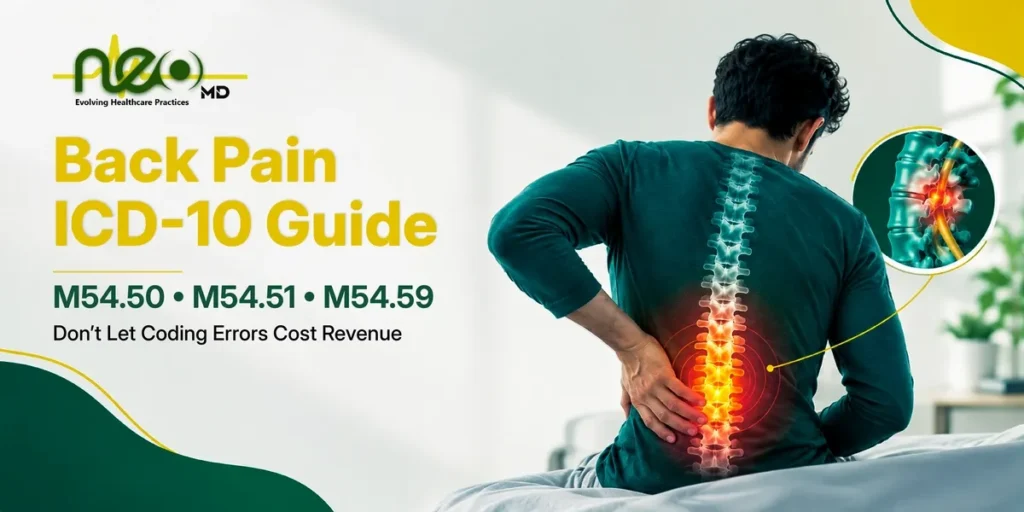
Back pain is simple to describe and surprisingly easy to code wrong. The diagnosed back pain icd 10 has to match the provider’s note, and it must not conflict with other codes on the claim. It also has to support whatever procedure you billed against it. Get one of those wrong and the claim is rejected, downcoded, or flagged for review—a costly error that specialized pain management billing services work aggressively to prevent.
This guide covers back pain ICD 10 coding for the FY2027 code set, which took effect October 1, 2026. It explains what changed across FY2026 and FY2027, how to choose between the M54 codes, when a definitive diagnosis replaces them, and how to match each diagnosis to the right service and payer.
Quick answer: The most commonly reported back pain ICD-10 code is M54.50 (low back pain, unspecified). Use M54.51 for vertebrogenic low back pain and M54.59 for other specified low back pain. Use M54.9 (dorsalgia, unspecified) when no spinal region is documented. M54.6 for thoracic spine pain and M54.2 for neck pain. The historical parent code M54.5 has been invalid since October 1, 2021.
Key takeaways
- There is no single ICD-10 code for back pain. The right code depends on region, pain type and whether a cause has been documented.
- M54.50, M54.51 and M54.59 have no laterality. M54.51 means vertebrogenic, not left-sided.
- The core M54 codes show no change in FY2027, but instructional notes change every year, so re-validate your Excludes edits.
- The date of service picks the code set, not the date you submit the claim.
- A documented cause (disc disorder, stenosis, strain) generally replaces the symptom code.
- G89 pain codes are limited by guideline. They need documented acute or chronic pain. They are not added when a definitive diagnosis already explains it, unless the visit is for pain management.
- Two Excludes1 codes can be reported together only when the conditions are unrelated. If it isn’t clear, query the provider.
Back pain ICD 10 codes at a glance
| Code | Description | Use when | Watch out for |
| M54.50 | Low back pain, unspecified | “Low back pain,” “lumbago” or “loin pain” with no further detail | Excludes1 with strain (S39.012), disc displacement (M51.2-) and lumbago with sciatica (M54.4-) |
| M54.51 | Vertebrogenic low back pain | Provider documents vertebral endplate origin | Provider must state it; imaging supports but does not replace the statement |
| M54.59 | Other low back pain | A specified pain type with no more specific code | Not a “right-sided” code |
| M54.9 | Dorsalgia, unspecified | Back pain with no region documented | High volume invites audit attention |
| M54.6 | Pain in thoracic spine | Upper or mid back pain | Excludes1 with thoracic disc disorders (M51.-) |
| M54.2 | Cervicalgia | Neck pain | Not for pain due to cervical disc disorder |
| M54.30 / .31 / .32 | Sciatica, unspecified / right / left | Sciatica without low back pain | Needs the 5th character |
| M54.40 / .41 / .42 | Lumbago with sciatica, unspecified / right / left | Low back pain and sciatica together | Do not add M54.5- |
| M54.16 / M54.17 | Radiculopathy, lumbar / lumbosacral | Nerve root involvement documented | Disc-related radiculopathy goes to M51.1- |
| G89.29 | Other chronic pain | Documented chronic pain, with a site code | Not for pain integral to a known diagnosis unless the visit is for pain management |
FY2026 and FY2027: what changed and what it means for back pain icd 10
Code set timeline
| Fiscal year | Effective dates | Headline changes | Back pain impact |
| FY2025 | Oct 1, 2024 – Sep 30, 2025 | Disc degeneration codes M51.36- and M51.37- expanded with a 6th character | Created new Excludes1 conflicts with M54.5- |
| FY2026 | Oct 1, 2025 – Sep 30, 2026 | 487 new, 28 deleted and 38 revised diagnosis codes | No change to M54.5x definitions in the sources I reviewed; several Excludes notes were reclassified |
| FY2027 | Oct 1, 2026 – Sep 30, 2027 | 190 new, 30 deleted and 4 revised codes | Core M54 codes show no change; verify the nine musculoskeletal deletions against your charge master |
FY2026: the quiet changes that still mattered
The headline for FY2026 was volume, with 487 new codes, mostly outside the spine. For back pain icd 10 billing, the part to remember is that several Excludes1 notes were changed to Excludes2 that year. A code pair that was blocked in one fiscal year can become reportable in the next, and your claim scrubber has to keep up in both directions.
FY2027: what to check
- Back pain icd-10 codes. The M54.5x family, M54.9 and M54.6 show no change for FY2027.
- Deletions in the M chapter. Nine of the 30 deleted codes sit in the musculoskeletal chapter (M00–M99). I could not confirm that any of them relate to back pain icd 10, so run your superbills and pick lists against the official deletion list.
- Other musculoskeletal updates. Plantar fasciitis moves into a new M67.A- subcategory, which matters for practices that bill lower-extremity conditions alongside spine care.
- Instructional notes. The FY2027 Tabular List includes new Excludes1 and Excludes2 notes. Some notes were converted from one type to the other. For example, D05 moves from Excludes1 to Excludes2. Re-check the notes at M54, M51 and M47 rather than assuming last year’s edits still apply.
- Official guidelines. The FY2027 guideline changes are minimal: one new guideline and four revised or expanded ones, covering hypertensive heart disease and crisis, genetic disorders and DES exposure. None of them touch back pain.
- Inpatient spine procedures. The FY2027 ICD-10-PCS update adds a new device value for lumbar and lumbosacral fusion using a custom-made interbody device. This matters for hospital and neurosurgery coding, not for professional-fee back pain claims.
The date-of-service rule
Code assignment follows the date of service or discharge, not the date the claim is submitted. A visit on September 30, 2026 uses FY2026 codes even if you send the claim in October. Many “invalid code” rejections right after October 1 come from a system applying the wrong year to older dates of service.
FY2027 readiness checklist
- Confirm your EHR, practice management system and clearinghouse loaded the FY2027 set.
- Remove deleted codes from pick lists, favorites and charge masters.
- Re-run Excludes1 and Excludes2 edits in your scrubber.
- Keep FY2026 loaded for any date of service through September 30, 2026.
- Check the official files on the CMS ICD-10 page and the FY2027 ICD-10-CM Official Guidelines, since figures in third-party summaries vary. Some early reports cite 238 new and 21 deleted codes, while the official addendum lists 190, 30 and 4.
CMS may also publish mid-year updates in some years, so check the CMS page rather than relying on a fixed calendar.
How ICD-10-CM classifies back pain
Back pain icd 10 sits in category M54 (dorsalgia) within Chapter 13 (musculoskeletal system). M54 is a symptom category. The Official Guidelines tell coders to report a definitive diagnosis rather than a symptom when the provider has established one, and to treat symptoms that are integral to a disease as already included in it.
That is why back pain icd-10 coding has two layers:
- Symptom coding. The provider documents pain in a region, but no cause (M54.9, M54.50, M54.51, M54.59, M54.6, M54.2).
- Definitive diagnosis coding. The provider documents a cause, and that code replaces the symptom (M51.-, M48.-, M47.-, M43.-, S39.012-, and others).
Low back pain icd 10 codes: M54.50, M54.51 and M54.59
M54.50: low back pain, unspecified
The Tabular List includes lumbago NOS, low back pain NOS and loin pain here. It fits an early visit, before a workup, when the provider has documented the region but not a type or cause. Treat it as a starting point. If the same code is still on claims after imaging and a full exam, the chart or the coding has fallen behind the clinical picture.
M54.51: vertebrogenic low back pain icd-10
This code describes pain that arises from the vertebral endplates. The treating provider has to document the diagnosis, and a radiology report alone is not enough. Many payers tie procedures such as basivertebral nerve ablation (CPT 64628 and 64629) to this diagnosis, and they typically expect chronic duration, failed conservative care and specific MRI findings such as Modic changes. Those are payer and clinical criteria, not part of the code definition, so check the payer’s policy before scheduling.
M54.59: other low back pain
Use it when the provider documents a specific pain type that has no more specific code and does not meet the vertebrogenic definition. The characterization has to come from the note, so if a coder cannot tell whether a descriptor supports “other specified,” send a query instead of guessing.
The laterality myth
Some references describe M54.51 as left-sided and M54.59 as right-sided. That is wrong. No M54.5x code carries a side. The last digit classifies the type of pain. Record the side in the clinical note for clinical accuracy, but the code stays the same.
M54.5 is retired
M54.5 was split into three codes effective October 1, 2021. A claim carrying the old code with a date of service on or after that day is rejected as invalid or incomplete. Check old superbills, EHR favorites and charge masters for it first, because it is the fastest fix in back pain icd-10 billing.
M54.9 and M54.89: when unspecified is acceptable
M54.9 is for “back pain” with no region documented. It is legitimate in a few situations:
- A first visit where the provider has not localized the pain yet
- Diffuse pain across the whole back with no single region
- A workers’ compensation or personal injury intake where a precise diagnosis awaits imaging or a specialist
It is the wrong code when the chart says “low back.” In that case M54.50 applies. A high share of M54.9 on your claims suggests providers are not documenting the region, which can draw payer scrutiny. The fix is documentation training, not a different code.
M54.89 (other dorsalgia) is a limited “other specified” code, not a workaround for choosing a region. Check the Excludes1 note at M54.8 in the current Tabular List before using it.
Workers’ comp and personal injury claims: these claims often get more scrutiny because lawyers, adjusters and payers all read the diagnosis. Document the mechanism of injury, the date, and how the injury connects to the complaint. If the provider documents a strain from the incident, the S39.012– code with the correct 7th character is more defensible than a generic dorsalgia code. Update the diagnosis when imaging comes back, and don’t leave an early M54.9 on the claim.
Thoracic and cervical codes
- M54.6 covers pain in the thoracic spine, whether the chart says upper back, mid back or between the shoulder blades. There is no separate mid-back code. It is Excludes1 with thoracic disc disorders (M51.-).
- M54.2 is cervicalgia. Report it with M54.6 only when the provider documents two distinct pain areas.
- M54.14 (thoracic radiculopathy) and M54.12 (cervical radiculopathy) apply. When nerve root involvement is documented.
Sciatica, lumbago with sciatica and radiculopathy
| Documentation says | Code family | Laterality |
| Sciatica only | M54.3- | Yes (0 unspecified, 1 right, 2 left) |
| Low back pain with sciatica | M54.4- | Yes (0 unspecified, 1 right, 2 left) |
| Lumbar or lumbosacral radiculopathy | M54.16 / M54.17 | No |
| Disc disorder with radiculopathy | M51.16 / M51.17 | No |
| Spondylosis with radiculopathy | M47.26 / M47.27 | No |
Key rules:
- M54.3 is not billable by itself. It needs the 5th character (M54.30, M54.31 or M54.32).
- Sciatica is a symptom pattern, while radiculopathy means nerve root dysfunction. They are not interchangeable.
- If the sciatica or radiculopathy is due to a disc disorder, code M51.1-, not M54.3-, M54.4- or M54.1-.
- Do not add M54.5x to M54.4x, because lumbago with sciatica already includes back pain icd 10.
Code the cause, not the symptom
| Documented condition | Codes | Notes |
| Disc degeneration with discogenic back pain icd 10 | M51.360 (lumbar), M51.370 (lumbosacral) | The 6th character shows back pain only (0), leg pain only (1), both (2), or neither mentioned (9) |
| Disc displacement without radiculopathy | M51.26 (lumbar), M51.27 (lumbosacral) | Displacement, not degeneration |
| Disc disorder with radiculopathy | M51.16 / M51.17 | Replaces M54.3-, M54.4-, M54.1- |
| Lumbar spinal stenosis | M48.061 / M48.062 | M48.06 needs a 6th character: without or with neurogenic claudication |
| Lumbar spondylosis without myelopathy or radiculopathy | M47.816 / M47.817 | Use M47.26 / M47.27 if radiculopathy is documented |
| Spondylolisthesis | M43.16 / M43.17 | Lumbar / lumbosacral |
| Low back strain | S39.012A / D / S | 7th character required |
| Lumbar sprain | S33.5XXA / D / S | The X placeholders are required |
| Sacroiliac joint dysfunction or sacrococcygeal disorder (including coccydynia) | M53.3 | Sacroiliitis is M46.1 |
| Back muscle spasm | M62.830 | When spasm is the documented finding |
| Postlaminectomy syndrome (failed back surgery syndrome) | M96.1 | Not for ordinary post-surgical pain |
Because M51.36- and M51.37- already describe the pain, don’t add M54.5x for the same pain. Confirm the current Excludes notes in the Tabular List.
Red-flag diagnoses that are not M54 codes
Back pain icd-10 can be the presenting symptom of a serious condition. When the provider documents one, the definitive diagnosis is reported, not a dorsalgia code:
| Condition | Code |
| Cauda equina syndrome | G83.4 |
| Secondary malignant neoplasm of bone | C79.51 |
| Collapsed vertebra, NEC (lumbar example) | M48.56X- (7th character required) |
| Discitis (lumbar example) | M46.46 |
Clinical red flags include fever, unexplained weight loss, a history of cancer, bowel or bladder changes, progressive neurological deficit and significant trauma. Documenting that these were screened for protects the provider, and it explains why a more serious diagnosis was or was not pursued.
Acute and chronic pain: the G89 family
There is no acute or chronic variant of M54. Chronicity is captured with the G89 category, and the guidelines place limits on it.
| Code | Description |
| G89.11 | Acute pain due to trauma |
| G89.18 | Other acute postprocedural pain |
| G89.21 | Chronic pain due to trauma |
| G89.28 | Other chronic postprocedural pain |
| G89.29 | Other chronic pain |
| G89.3 | Neoplasm-related pain |
| G89.4 | Chronic pain syndrome |
The rules that matter, per the Official Guidelines (Section I.C.6.b):
- G89 codes need documented acute or chronic pain. If the provider doesn’t specify, they are not assigned (neoplasm pain and chronic pain syndrome are the exceptions).
- G89 is not assigned when a definitive diagnosis is known, unless the encounter is for pain control or management rather than for the underlying condition.
- G89.4 requires the provider to document chronic pain syndrome. Chronic pain alone does not qualify.
- ICD-10-CM does not define “chronic” by a number of weeks. The duration comes from the provider, though payer policies set their own thresholds.
Sequencing follows the reason for the visit:
| Encounter reason | First-listed | Second |
| Evaluating or treating the back condition | M54.5x or the definitive diagnosis | G89.29, if documented and allowed |
| Pain control or management (for example, an injection for pain) | G89.29 | The site or cause code |
For pain management patients on long-term opioids, the provider may also document Z79.891 (long-term current use of opiate analgesic) as a supporting code.
Excludes1 and Excludes2: how to read them
- Excludes1 means “not coded here.” The two conditions are not reported together.
- Excludes2 means the excluded condition is not part of the code’s definition. So both can be reported when the patient has both.
The exception. The Official Guidelines allow an Excludes1 pair to be reported together when the two conditions are unrelated to each other, and if it is unclear whether they are related, the coder should query the provider. This still applies in FY2027.
| If you report | Do not also report (check the current Tabular List) | Why |
| M54.5- | M54.4- | Sciatica component already included |
| M54.5- | M51.2- | A disc disorder explains the pain |
| M54.5- | S39.012- | The strain is the specific cause |
| M54.5- | M51.360 / M51.370 for the same pain | The disc code already describes it |
| M54.3- | M54.4-, M51.1- | Already included or explained |
| M54.6 | M51.- thoracic disc disorders | Disc disorder explains the pain |
Because notes get reclassified between Excludes1 and Excludes2 over time (as in FY2026 and FY2027), check the current Tabular List before building or updating scrubber rules.
Documentation rules coders cannot skip
- The treating provider documents the diagnosis. Do not assign M54.51 or a disc code from a radiology report alone.
- Outpatient uncertain diagnoses are not coded. Terms such as probable, suspected or rule out mean you code the documented symptom (Section IV.H of the Guidelines).
- Code to the highest certainty and specificity the record supports.
- Update the diagnosis as the workup progresses. Continuing to report M54.50 after the provider documents a herniated disc undercodes the encounter.
- Link cause and effect. An acute flare of a chronic problem needs a sentence connecting the two.
Documentation checklist for providers:
- Spinal region (cervical, thoracic, lumbar, lumbosacral)
- Pain type or cause (vertebrogenic, mechanical, discogenic, radicular, traumatic)
- Onset and duration, including the word “chronic” when it applies
- Side, for sciatica and radicular symptoms
- Objective findings (range of motion, tenderness, neuro exam)
- Imaging results, as interpreted by the treating provider
- Functional limitations
- Red-flag screening and plan of care
- Reason for the encounter (evaluation, treatment or pain management)
Specialty billing guide
Primary care and urgent care. E/M visits (for example 99213 or 99214) with a specific region in the note. Avoid defaulting to M54.9. Maintaining compliance with baseline primary care billing services keeps documentation tight across both clinics.
Physical therapy. Payers look for measurable functional deficits, goals and progress, not just a diagnosis. The medical diagnosis and the treatment diagnosis may differ (for example M62.81 or R26.2 as treatment diagnoses), that’s why Neo MD physical therapy billing team follows each payer’s instructions. Accurate claims submission is heavily dependent on specific medical necessity parameters for processing.
Chiropractic. For Medicare, chiropractic manipulative treatment (98940–98942) *requires a subluxation code as the primary diagnosis (M99.00–M99.05 by region) with the AT modifier for active treatment. A secondary neuromusculoskeletal diagnosis (for example M54.50 or M54.6) supports medical necessity. Subluxation has to be documented through the required exam criteria or imaging. Commercial payers vary. Navigating these regional and commercial rules requires specialized chiropractic billing services to safeguard revenue pipelines.
Pain management and interventional procedures. Epidural injections (62323, 64483), facet procedures (64493, 64635) and BVN ablation (64628) are governed by payer or LCD criteria: diagnosis lists, duration, failed conservative care, imaging and functional scores. Match the diagnosis to the policy before scheduling. The CMS Medicare Coverage Database is the place to start for Medicare policies.
Orthopedics and neurosurgery. Report the definitive diagnosis. For hospital-based spine procedures, the ICD-10-PCS update is a separate checklist item. Staff should cross-reference all clinical entries with established orthopedic billing guidelines to confirm code sequencing validity.
Acupuncture for chronic low back pain (Medicare). NCD 30.3.3 covers it for pain lasting 12 weeks or more that is nonspecific, with no systemic cause, and not related to surgery or pregnancy. Coverage is limited to a set number of sessions per period, with more allowed when improvement is documented. Verify the current covered diagnosis list in the NCD.
Workers’ compensation and personal injury. Document the mechanism and date of injury. Use the injury code family with the correct 7th character, and keep the diagnosis consistent from the first visit to the demand package.
Pregnancy. Pregnancy-related back pain icd-10 is classified in Chapter 15, typically O26.89- with the trimester as the 6th character (for example O26.891 for the first trimester). Pre-existing conditions complicated by pregnancy may use O99.89 instead. Chapter 15 codes take sequencing priority. Following proper protocol for obgyn billing prevents claim rejection when reporting these multi-chapter pregnancy combinations.
Pairing back pain icd 10 diagnoses with CPT codes
| Diagnosis | Frequently paired services | What payers look for |
| M54.50 / M54.59 | E/M, 97110, 97140, 98940–98942 | Functional deficits, goals, medical necessity |
| M54.51 | E/M, 72148, 64628 | Chronic duration, failed conservative care, MRI findings |
| M54.3- / M54.4- | E/M, 72148, 64483, 95907–95913 | Side, dermatomal findings, neuro exam |
| M51.16 / M51.17 | E/M, 72148, 62323, 64483 | Imaging that matches the symptoms |
| G89.29 (pain management) | E/M, 64493, 20552 | Treatment intent and prior therapy |
Imaging. Clinical guidance, including the ACR Appropriateness Criteria and Choosing Wisely recommendations, generally discourages routine imaging for nonspecific low back pain in the first weeks without red flags. Many payers apply prior authorization or conservative-care requirements to advanced imaging, so confirm each payer’s rules. For CPT descriptions and guidelines, use the AMA CPT resources.
Quality reporting and audit exposure
- Quality measures. Programs such as HEDIS include a low back pain icd 10 imaging measure that relies on diagnosis codes to decide which patients are counted. An unspecified or wrong code can change who lands in the measure, so check the current measure specifications each year.
- Audit risk. Unspecified codes alone are not a violation, but a pattern of them with services that require more specificity draws questions. Coding the same unspecified diagnosis across many visits and providers is the pattern payers notice.
- Compliance habit. Keep a record of provider queries and the answers, so you can show the diagnosis came from the clinician.
Back pain claim denials and how to fix them
| Denial (CARC) | Typical cause | Fix |
| CO-16 (missing or invalid information) | Retired code, missing 5th, 6th or 7th character | Correct the code and resubmit |
| CO-11 (diagnosis inconsistent with procedure) | ICD-10 and CPT do not match | Verify the diagnosis supports the service, and fix |
| CO-50 (not medically necessary) | Documentation did not establish necessity | Appeal with objective findings, imaging and failed conservative care |
| CO-167 (diagnosis not covered) | The diagnosis is not on the payer’s covered list for that service | Check the LCD or payer policy, code to documented specificity, and appeal |
| CO-197 (authorization absent) | Imaging or procedure without prior authorization | Request a retro-authorization if allowed; fix front-end checks |
| CO-29 (timely filing) | Filed after the payer’s deadline | Fix the workflow; appeal only with proof of timely filing |
You can look up any reason code on the X12 claim adjustment reason code list, or you can streamline your revenue cycle by reviewing the Neo MD expert guide to claim denials management.
Appeal steps
- Read the remittance and identify the exact reason and any remark codes.
- Check the code first. Is it valid for the date of service, complete, and free of Excludes1 conflicts?
- Pull the record and confirm it supports the code and service billed.
- Fix and resubmit if it is a coding error. Appeal only if the original claim was correct.
- Write the appeal with the diagnosis, the service, the policy and the supporting notes, imaging and treatment history.
- Watch deadlines. Medicare Part B redeterminations generally have to be requested within 120 days of the initial determination. Commercial deadlines vary by contract.
- Track the pattern. Three denials with the same cause call for a template, scrubber or training fix.
Top Back Pain ICD 10 Coding Mistakes
- Billing the retired M54.5
- Defaulting to M54.50 when the chart supports something more specific
- Reporting M54.5x with M54.4x, S39.012 or M51.2-
- Believing M54.51 or M54.59 indicate a side
- Using M54.9 when the region is documented
- Omitting G89.29 when chronicity is documented, or adding it when pain is integral to the diagnosis
- Reporting M48.06 without the 6th character
- Leaving off the 7th character on S-codes
- Coding probable or suspected diagnoses in the outpatient setting
- Pulling a diagnosis from a radiology report the treating provider never documented
30-day back pain revenue-leak audit
Pull your last month of back pain claims and check:
- Any M54.5 without a 5th character
- The share of M54.9 and M54.50 compared with specific codes
- Excludes1 collisions (M54.5- with M54.4-, M51.2-, S39.012-)
- Missing 5th, 6th or 7th characters (M54.3-, M48.06-, S39.012-)
- G89 added when a definitive diagnosis already explains the pain, or missing when it clearly applies
- First-listed diagnosis that does not match the reason for the visit
- Procedures billed without the diagnosis or authorization the payer requires
- Any date of service on or after October 1, 2026 still billed with a deleted FY2026 code
Clinical scenarios
| Scenario | Code | Why |
| Two weeks of low back pain, no trauma, no workup | M54.50 | Region documented, no cause or type |
| Provider documents vertebrogenic low back pain with Modic changes | M54.51 | Specified type, provider-documented |
| Mechanical low back pain, no disc or nerve findings | M54.59 | Specified type, no more specific code |
| Low back pain with right leg sciatica | M54.41 | Lumbago with sciatica, right |
| MRI-confirmed L4-L5 herniation with radiculopathy, documented by provider | M51.16 | Cause replaces the symptom |
| Lifting injury at work, muscle strain, first visit | S39.012A | Injury code, initial encounter |
| Mid-back pain from prolonged sitting | M54.6 | Thoracic spine pain |
| “Back pain,” no region | M54.9 | Region not documented |
| Chronic low back pain, visit is for a pain injection | G89.29 first, then the site or cause code | Encounter is for pain control |
| Back pain with a cauda equina diagnosis | G83.4 | Serious diagnosis, not a dorsalgia code |
How NEO MD helps with back pain icd 10 billing
Knowing the code is half the job. The other half is making sure every claim is coded, submitted and followed up the same way, visit after visit, across every provider and payer. NEO MD supports practices with revenue cycle management, medical credentialing, front office management, MIPS consulting and medical billing services.
For back pain practices, that means:
- Accurate diagnosis coding, with Excludes checks before claims go out
- Fewer denials, with eligibility and prior authorization support for imaging, injections and therapy
- Denial root-cause review, so repeat CO-16, CO-11, CO-50 and CO-167 denials get fixed at the source
- Faster enrollment, so new providers can start billing sooner
- Specialty workflows for chiropractic, physical therapy, pain management, orthopedic and primary care practices
Not sure where your back pain claims are leaking revenue? Request a free billing audit from NEO MD and see which coding gaps and denial patterns are costing you money.
Frequently asked questions
What is the ICD-10 code for back pain?
There is no single code. M54.9 is used when no region is documented, M54.50 for low back pain, and M54.6 for thoracic back pain.
What is the ICD-10 code for low back pain?
M54.50 (unspecified), M54.51 (vertebrogenic) or M54.59 (other specified).
Did the back pain ICD 10 codes change in FY2027?
The core M54 codes show no change. Instructional notes and other codes change each year, so check the official FY2027 addenda.
What replaced M54.5?
M54.50, M54.51 and M54.59, effective October 1, 2021.
Do M54.51 and M54.59 mean left and right?
No. They describe the type of pain. M54.5x codes have no laterality.
What is the ICD-10 code for chronic low back pain?
There is no single code. Report the site code and add G89.29 when chronic pain is documented and the guidelines allow it.
Can M54.50 and M54.41 be reported together?
No, because they have an Excludes1 relationship. Use M54.41 or M54.42 when lumbago with sciatica is documented.
What is the ICD-10 code for upper or mid back pain?
M54.6, pain in thoracic spine.
What is the ICD-10 code for sciatica?
M54.30, M54.31 or M54.32, unless a disc disorder causes it. In that case it is M51.1-.
Which code set applies to a visit on September 30, 2026?
FY2026, because the date of service decides the code set, not the submission date.
Can two Excludes1 codes ever be reported together?
Yes, when the provider documents that the conditions are unrelated. Query the provider if it is unclear.
Is there a code for severe or intractable back pain?
No. Severity belongs in the clinical note, and payers use it to judge medical necessity.
Conclusion
Strong back pain ICD 10 coding comes down to a few habits. Use only valid codes for the date of service, code to the specificity the chart supports, and replace the symptom with the cause when one is documented. Respect Excludes rules and keep your scrubber current, and match every diagnosis to a service the payer will cover. With the FY2027 code set now in effect, this is a good moment to run the revenue-leak audit and clean up your templates.